Ethereum vs. Bitcoin: ETH price poised for 80% rally in 2026

cointelegraphОпубликовано 2025-12-11Обновлено 2025-12-11

Введение

Ethereum's Ether (ETH) could surge over 80% against Bitcoin (BTC) in 2026, according to a bullish inverse head-and-shoulders pattern forming on its long-term chart. The pattern suggests a potential rise toward 0.059–0.063 BTC. This mirrors a similar 2019-2020 accumulation phase that preceded a 450% rally. However, ETH remains constrained by a multi-year descending trendline that has capped gains since 2017. A rejection at this resistance could invalidate the bullish setup and trigger a decline back to 0.0175 BTC support. The analysis highlights both the optimistic scenario and key risks, emphasizing that the long-term downtrend against Bitcoin is not yet definitively broken.

Ethereum’s Ether (ETH) token may rally by over 80% versus Bitcoin (BTC) in 2026, according to a classic bullish reversal scenario developing on its long-term charts.

Key points:

  • ETH/BTC charts point to a potential move toward 0.059–0.063 BTC in 2026.

  • Rejection at the long-term trendline could send the pair back toward 0.0175 BTC.

Ether price chart hints at 80% rally versus Bitcoin

As of December, ETH/BTC’s 2-week chart displayed a textbook inverse head-and-shoulders (IH&S) formation, a classic bullish reversal pattern that typically follows prolonged downtrends.
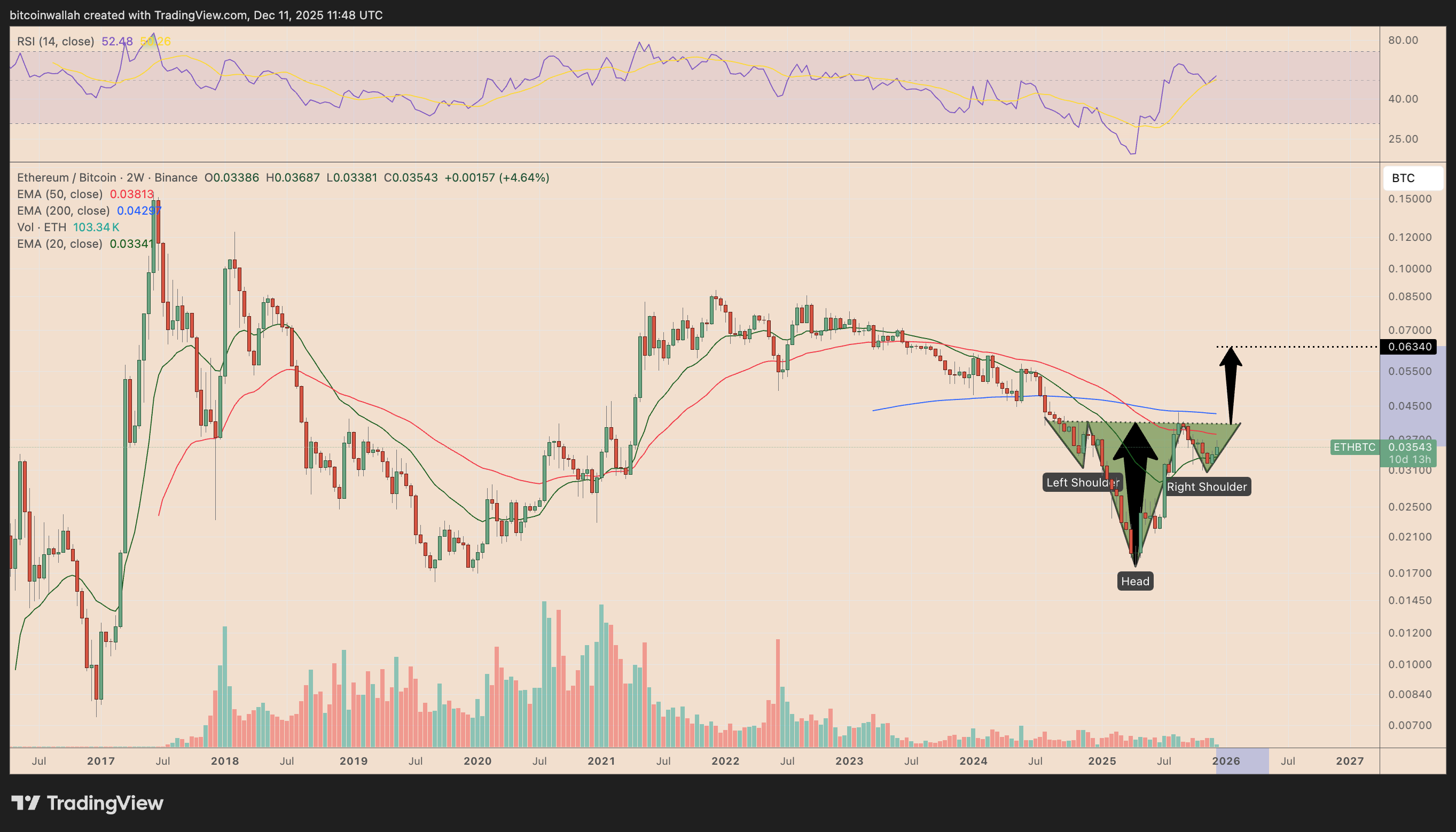
ETH/BTC two-week chart. Source: TradingView

The pattern’s left shoulder formed during late-2024 weakness, followed by an aggressive capitulation in April 2025 that carved out the head around 0.0176 BTC. This subsequent recovery established a higher low in Q4 2025, forming the right shoulder.

The neckline was around 0.0400 BTC, situated between the 50-period (red) and 200-period (blue) exponential moving averages (EMAs).

Related: Ethereum rising to $3.3K proves bottom is in: Is 100% ETH rally next?

A decisive breakout above this zone will likely confirm the IH&S pattern, paving the way for a measured move toward 0.063 BTC in 2026.

This upside target was up 80% from the ETH/BTC rates recorded as of Thursday.

Can ETH copy its 450% parabolic move from 2020?

ETH/BTC’s current rebound closely mirrored the breakout that followed its 2019-2020 accumulation phase.

The pair rallied nearly 450% after bottoming within the same 0.0160–0.0200 BTC demand zone.
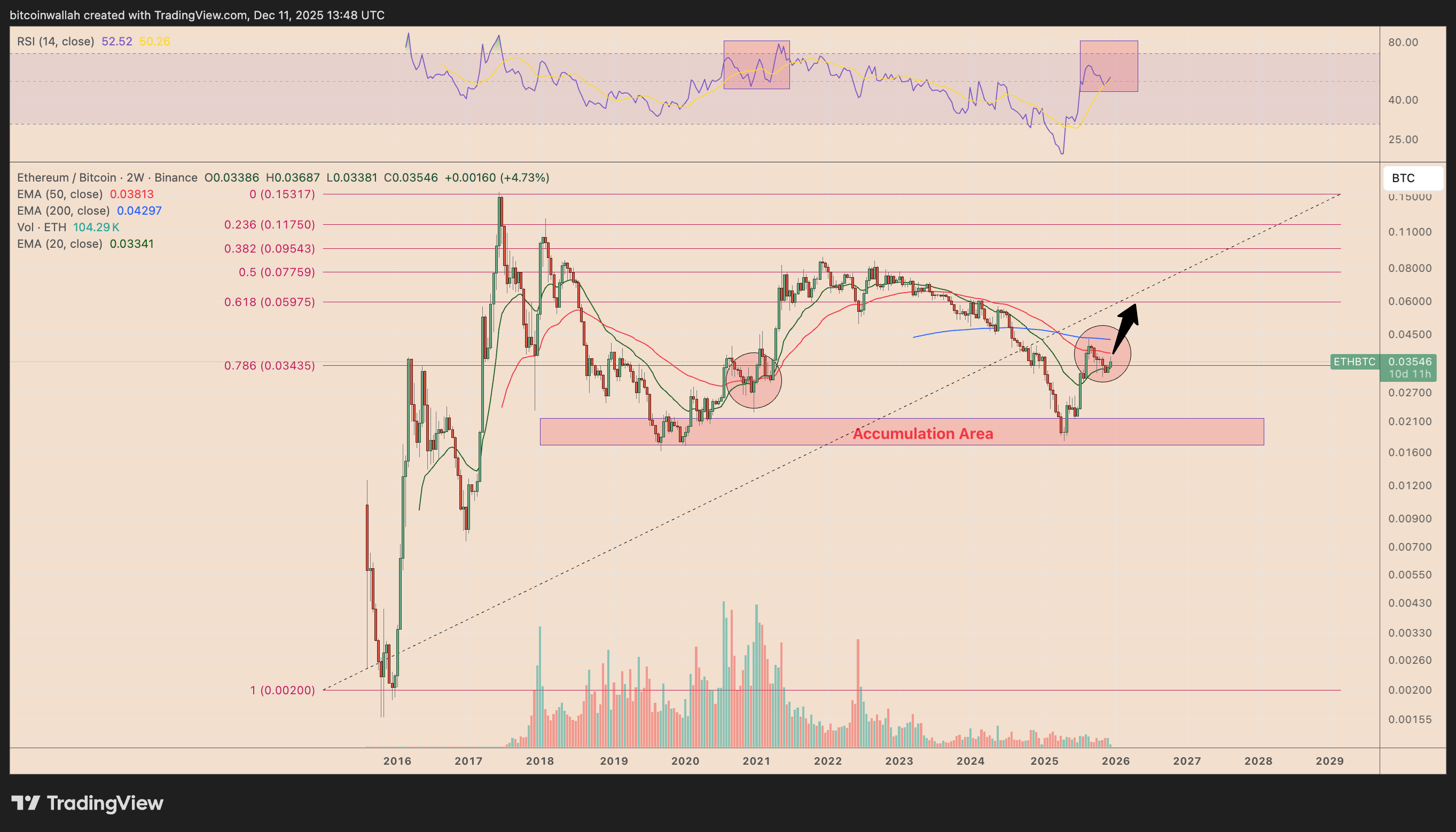
ETH/BTC two-week chart. Source: TradingView

Ether’s 2025 recovery originated from this identical structural floor, and price is now pressing into the same early-stage resistance cluster (represented via red circles in the chart above) that preceded the 2020 parabolic expansion.

ETH/BTC could climb toward the 0.059 BTC Fibonacci zone, a level consistent with the IH&S breakout trajectory heading into 2026, if this fractal continues to play out.

Ethereum is still in a downtrend vs. Bitcoin

However, the ETH bulls will have to prove that the long-term downtrend is actually over.

Ether remains capped by a multiyear descending trendline that has rejected every breakout attempt against Bitcoin since 2017.
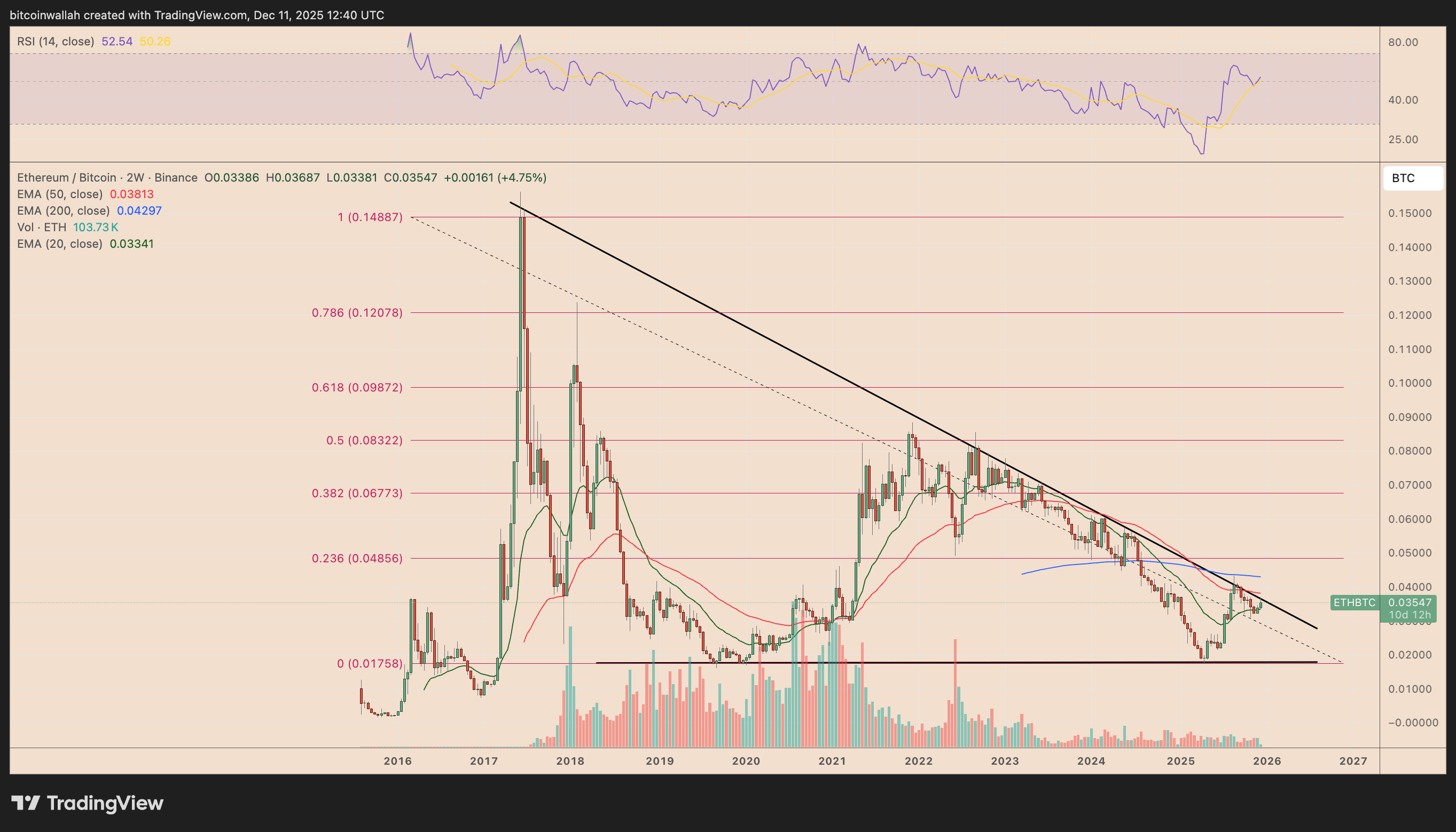
ETH/BTC two-week chart. Source: TradingView

A fresh failure at this barrier would undermine the IH&S and fractal setups and raise the risk of a pullback toward the long-standing 0.0175 BTC support in 2026.

This article does not contain investment advice or recommendations. Every investment and trading move involves risk, and readers should conduct their own research when making a decision. While we strive to provide accurate and timely information, Cointelegraph does not guarantee the accuracy, completeness, or reliability of any information in this article. This article may contain forward-looking statements that are subject to risks and uncertainties. Cointelegraph will not be liable for any loss or damage arising from your reliance on this information.


Похожее

Farewell to the Copper Era: Understanding the Logic of the AI Silicon Photonics Industry Chain and Key US Stock Players

**Summary: The Era of Silicon Photonics and Key AI Infrastructure Stocks** The article delves into the transition from copper-based interconnects to silicon photonics (SiPh) as a critical enabler for next-generation AI data centers. It explains that copper faces fundamental physical limits—the bandwidth wall, density wall, and power wall—at high data rates (1.6T+), making a material shift essential. Silicon photonics, which integrates components like lasers, modulators, and detectors onto a silicon chip, offers a solution by leveraging mature CMOS manufacturing for cost-effective, high-volume production. A key challenge is that silicon itself is not an efficient light source, making Indium Phosphide (InP) lasers a critical and supply-constrained component. A major industry catalyst was NVIDIA's 2025 GTC announcement, declaring optical interconnects a "standard" from its Rubin platform onward, followed by strategic investments to secure the supply chain. The industry is structured in four key layers: 1. **Foundries:** TSMC leads with its COUPE platform, while Tower Semiconductor (specialized SiPh foundry) and GlobalFoundries are major players. 2. **Core Component Suppliers:** Lumentum is highlighted as the sole volume manufacturer of the crucial 200G/lane EML laser, with orders locked by NVIDIA through 2027. 3. **Module & System Manufacturers:** Coherent holds significant market share, with Chinese manufacturers like InnoLight also noted for scale. 4. **System Integrators:** NVIDIA, Broadcom, and Marvell dominate this layer, setting standards and integrating technology. The article identifies core public investment targets: **NVIDIA (NVDA)** as the ecosystem driver; **Broadcom (AVGO)** and **Marvell (MRVL)** in networking/switching chips; **Lumentum (LITE)** and **Coherent (COHR)** for critical components; and foundries **TSMC (TSM)** and **Tower Semiconductor (TSEM)**. Private companies Lightmatter and Ayar Labs are noted as key IPO candidates. The silicon photonics shift is driving a re-rating of company valuations, moving them from traditional telecom/industrial metrics to premium AI infrastructure multiples. The industry features high barriers to entry (e.g., multi-year lead times for InP laser capacity, complex 3D integration/thermal management, and lengthy customer qualification cycles), suggesting a "winner-takes-most" dynamic. Risks include dependence on hyperscaler capex cycles, potential technology disruption among competing optical approaches (LPO, CPO, OCS, Optical I/O), and a timeline where widespread CPO deployment may not occur until ~2028, with LPO serving as a transitional technology. The conclusion advises that betting on the overall industry trend may be safer than betting on any single company.

marsbit39 мин. назад

Farewell to the Copper Era: Understanding the Logic of the AI Silicon Photonics Industry Chain and Key US Stock Players

marsbit39 мин. назад

Deconstructing the Real Risks of DeFi Lending: Annual Loss Rate Only 0.03%

Deconstructing the true risks of DeFi lending reveals an annual loss rate of only 0.03% from hacks and exploits. Analysis of DeFi Llama data (excluding cross-chain bridge incidents) for EVM and Solana lending protocols shows that despite high historical attack frequency due to concentrated assets, the sector's security has matured significantly. Over the past year, non-cross-chain lending on these chains saw gross losses of $309M, with net losses after recoveries at $301M. Against a daily average TVL of $99.6B, this translates to a minimal annualized loss rate of approximately 0.03%. The Euler Finance case in 2023, where $197M was fully recovered, exemplifies improving asset recovery capabilities, which now account for roughly 20% of losses in this sector. Loss events follow a log-normal distribution: most are small-scale, with catastrophic losses being rare outliers. This pattern, combined with the massive scale of the total lending market, means single incidents rarely impact the broader ecosystem. It underscores the effectiveness of portfolio diversification and provides a basis for sustainable insurance models. The data indicates DeFi lending has entered a mature phase where risks are quantifiable, categorized, and manageable. The actual financial loss relative to the total capital deployed is extremely low, challenging prevailing narratives of systemic risk.

marsbit40 мин. назад

Deconstructing the Real Risks of DeFi Lending: Annual Loss Rate Only 0.03%

marsbit40 мин. назад

POLY's Appearance Hints Are Getting Denser, How Far Away Is the Polymarket Airdrop?

**POLY Debut Hints Grow More Frequent: How Far is the Polymarket Airdrop?** Recent continuous hints from Polymarket team members regarding the POLY token have sparked widespread analysis within airdrop communities about its launch timeline and potential scale. According to predict.fun data, the probability of "Polymarket launching its official token before year-end 2025" currently stands at 56%. Hints about POLY began in October 2024. CEO Shayne Coplan's social media post mentioning $POLY alongside major cryptocurrencies first fueled speculation. This was followed by Growth Lead William LeGate discussing "prospective airdrop farmers," and CMO Matthew Modabber explicitly confirming that "Polymarket will have a token, and there will be an airdrop." The momentum continued into 2025. In April, major crypto data platforms CoinGecko and CoinMarketCap created placeholder pages for POLY, further solidifying expectations. May saw discussions shift towards token utility and airdrop criteria. A team member's "Soon" reply to a question about staking POLY for fee reductions, and a leaked internal screenshot showing an "Airdrop" tab, significantly increased anticipation. LeGate also outlined potential airdrop qualifiers, mentioning badges for employees, high-volume/high-profit traders, and ecosystem builders. He suggested that linking a Polymarket account to X (Twitter), sharing trades and market insights, and actively engaging with the community might constitute part of the eligibility criteria, leading to a surge in related social media activity. Despite the growing hype, the article's author expresses a personal view that Polymarket might prioritize platform stability and infrastructure upgrades—especially with the upcoming World Cup—over an immediate token launch, opting for a post-event release. Their current strategy involves hedging positions across prediction markets, actively trading on Polymarket, and engaging on social media to potentially qualify for a future airdrop.

Odaily星球日报1 ч. назад

POLY's Appearance Hints Are Getting Denser, How Far Away Is the Polymarket Airdrop?

Odaily星球日报1 ч. назад

Торговля

Спот
Фьючерсы

Популярные статьи

Тест по Bitcoin Биткоина

HTX Learn: Изучите Bitcoin halving и Заработаете Токены USDT

3.0k просмотров всегоОпубликовано 2024.04.16Обновлено 2024.04.16

Тест по Bitcoin  Биткоина

Что такое $BITCOIN

ЦИФРОВОЕ ЗОЛОТО ($BITCOIN): Комплексный анализ Введение в ЦИФРОВОЕ ЗОЛОТО ($BITCOIN) ЦИФРОВОЕ ЗОЛОТО ($BITCOIN) — это проект на основе блокчейна, работающий в сети Solana, который стремится объединить характеристики традиционных драгоценных металлов с инновациями децентрализованных технологий. Хотя он носит имя Биткойн, часто называемого “цифровым золотом” из-за его восприятия как средства хранения ценности, ЦИФРОВОЕ ЗОЛОТО является отдельным токеном, предназначенным для создания уникальной экосистемы в ландшафте Web3. Его цель — позиционировать себя как жизнеспособный альтернативный цифровой актив, хотя детали его применения и функциональности все еще развиваются. Что такое ЦИФРОВОЕ ЗОЛОТО ($BITCOIN)? ЦИФРОВОЕ ЗОЛОТО ($BITCOIN) — это токен криптовалюты, специально разработанный для использования в блокчейне Solana. В отличие от Биткойна, который выполняет широко признанную роль хранения ценности, этот токен, похоже, сосредоточен на более широких приложениях и характеристиках. Примечательные аспекты включают: Инфраструктура блокчейна: Токен построен на блокчейне Solana, известном своей способностью обрабатывать высокоскоростные и недорогие транзакции. Динамика предложения: ЦИФРОВОЕ ЗОЛОТО имеет максимальное предложение, ограниченное 100 квадриллионами токенов (100P $BITCOIN), хотя детали о его обращающемся предложении в настоящее время не раскрыты. Утилита: Хотя точные функциональные возможности не описаны, есть указания на то, что токен может быть использован для различных приложений, потенциально связанных с децентрализованными приложениями (dApps) или стратегиями токенизации активов. Кто создатель ЦИФРОВОГО ЗОЛОТА ($BITCOIN)? На данный момент личность создателей и команды разработчиков, стоящих за ЦИФРОВЫМ ЗОЛОТОМ ($BITCOIN), остается неизвестной. Эта ситуация типична для многих инновационных проектов в области блокчейна, особенно тех, которые связаны с децентрализованными финансами и феноменом мем-криптовалют. Хотя такая анонимность может способствовать культуре, ориентированной на сообщество, она усиливает опасения по поводу управления и ответственности. Кто инвесторы ЦИФРОВОГО ЗОЛОТА ($BITCOIN)? Доступная информация указывает на то, что у ЦИФРОВОГО ЗОЛОТА ($BITCOIN) нет известных институциональных спонсоров или значительных венчурных капиталовложений. Проект, похоже, функционирует по модели пирингового взаимодействия, сосредоточенной на поддержке и принятии сообществом, а не на традиционных путях финансирования. Его активность и ликвидность в основном сосредоточены на децентрализованных биржах (DEX), таких как PumpSwap, а не на устоявшихся централизованных торговых платформах, что еще больше подчеркивает его подход, ориентированный на grassroots. Как работает ЦИФРОВОЕ ЗОЛОТО ($BITCOIN) Операционные механизмы ЦИФРОВОГО ЗОЛОТА ($BITCOIN) можно подробно описать на основе его дизайна блокчейна и характеристик сети: Механизм консенсуса: Используя уникальный механизм доказательства истории (PoH) Solana в сочетании с моделью доказательства доли (PoS), проект обеспечивает эффективную валидацию транзакций, что способствует высокой производительности сети. Токеномика: Хотя конкретные дефляционные механизмы не были подробно описаны, большое максимальное предложение токенов подразумевает, что оно может быть предназначено для микротранзакций или нишевых случаев использования, которые еще предстоит определить. Интероперабельность: Существует потенциал для интеграции с более широкой экосистемой Solana, включая различные платформы децентрализованных финансов (DeFi). Однако детали относительно конкретных интеграций остаются неуточненными. Хронология ключевых событий Вот хронология, которая подчеркивает значимые вехи, касающиеся ЦИФРОВОГО ЗОЛОТА ($BITCOIN): 2023: Первоначальное развертывание токена происходит в блокчейне Solana, отмеченное его адресом контракта. 2024: ЦИФРОВОЕ ЗОЛОТО приобретает видимость, когда оно становится доступным для торговли на децентрализованных биржах, таких как PumpSwap, позволяя пользователям обменивать его на SOL. 2025: Проект наблюдает спорадическую торговую активность и потенциальный интерес к инициативам, возглавляемым сообществом, хотя на данный момент не зафиксировано никаких значительных партнерств или технических достижений. Критический анализ Сильные стороны Масштабируемость: Основная инфраструктура Solana поддерживает высокие объемы транзакций, что может повысить полезность $BITCOIN в различных сценариях транзакций. Доступность: Потенциально низкая цена торговли за токен может привлечь розничных инвесторов, способствуя более широкому участию благодаря возможностям дробного владения. Риски Отсутствие прозрачности: Отсутствие публично известных спонсоров, разработчиков или процесса аудита может вызвать скептицизм относительно устойчивости и надежности проекта. Волатильность рынка: Торговая активность сильно зависит от спекулятивного поведения, что может привести к значительной волатильности цен и неопределенности для инвесторов. Заключение ЦИФРОВОЕ ЗОЛОТО ($BITCOIN) является интригующим, но неоднозначным проектом в быстро развивающейся экосистеме Solana. Хотя он пытается использовать нарратив “цифрового золота”, его отход от установленной роли Биткойна как средства хранения ценности подчеркивает необходимость более четкого различения его предполагаемой утилиты и структуры управления. Будущее принятие и усвоение, вероятно, будут зависеть от решения текущей непрозрачности и более четкого определения его операционных и экономических стратегий. Примечание: Этот отчет охватывает синтезированную информацию, доступную на октябрь 2023 года, и с тех пор могут произойти события.

99 просмотров всегоОпубликовано 2025.05.13Обновлено 2025.05.13

Что такое $BITCOIN

Fractal Bitcoin: масштабирование Биткоина с помощью рекурсивной системы

Fractal Bitcoin — масштабное Layer-1-решнение, созданное на базе кода Биткоина, позволяющего достигать бесконечного масштабирования с помощью рекурсивного подхода.

2.3k просмотров всегоОпубликовано 2025.06.30Обновлено 2025.06.30

Fractal Bitcoin: масштабирование Биткоина с помощью рекурсивной системы

Обсуждения

Добро пожаловать в Сообщество HTX. Здесь вы сможете быть в курсе последних новостей о развитии платформы и получить доступ к профессиональной аналитической информации о рынке. Мнения пользователей о цене на BTC (BTC) представлены ниже.

活动图片